
In recent weeks, I have been reminded, quietly but profoundly, that some of the most important work in our world does not happen in public chambers or under media lights, but in conversations grounded in faith, humility, and responsibility.
In London, on 24 January 2026, I had the privilege of meeting Dr Murtaza Samiwala, International Private Secretary to His Holiness Dr Syedna Mufaddal Saifuddin Saheb TUS, the spiritual leader of the Dawoodi Bohra community. Our discussion centred on a simple but powerful idea: the value of dialogue between faiths at a time when division, suspicion, and noise too often dominate global discourse
What struck me was not the formality of the proposal, but its spirit. The correspondence shared with me, addressed with dignity, restraint, and deep respect, was not framed as an act of diplomacy, but as an act of conscience. It spoke of peace, compassion, coexistence, and shared responsibility for the vulnerable. These are not abstract ideals; they are the common moral language of all great faith traditions.
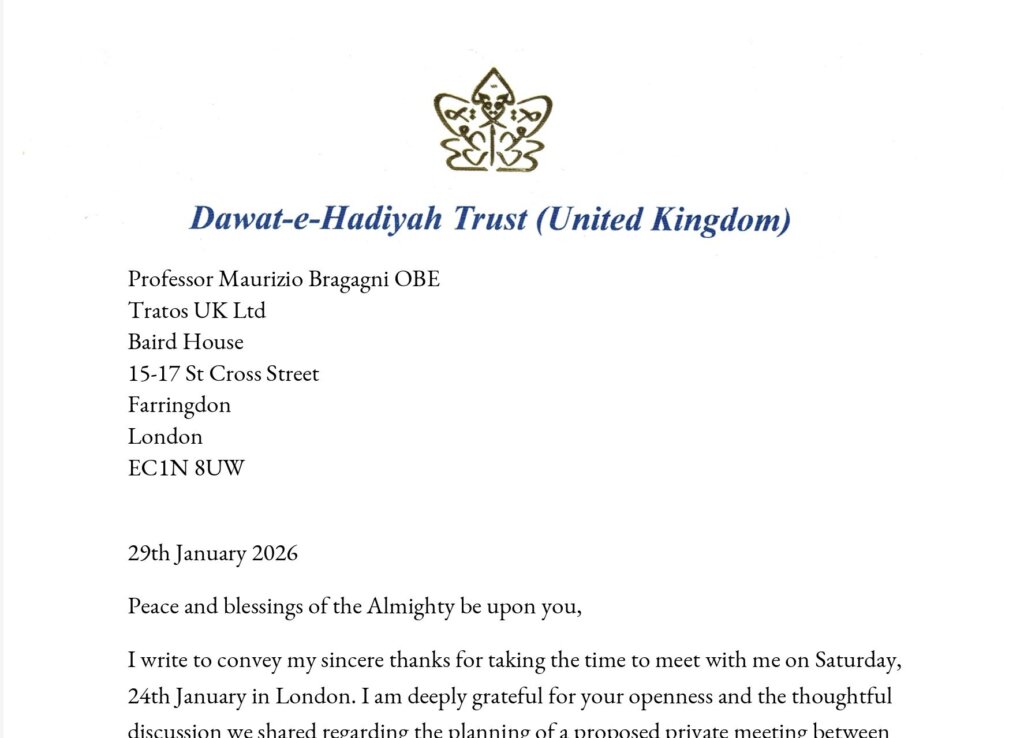
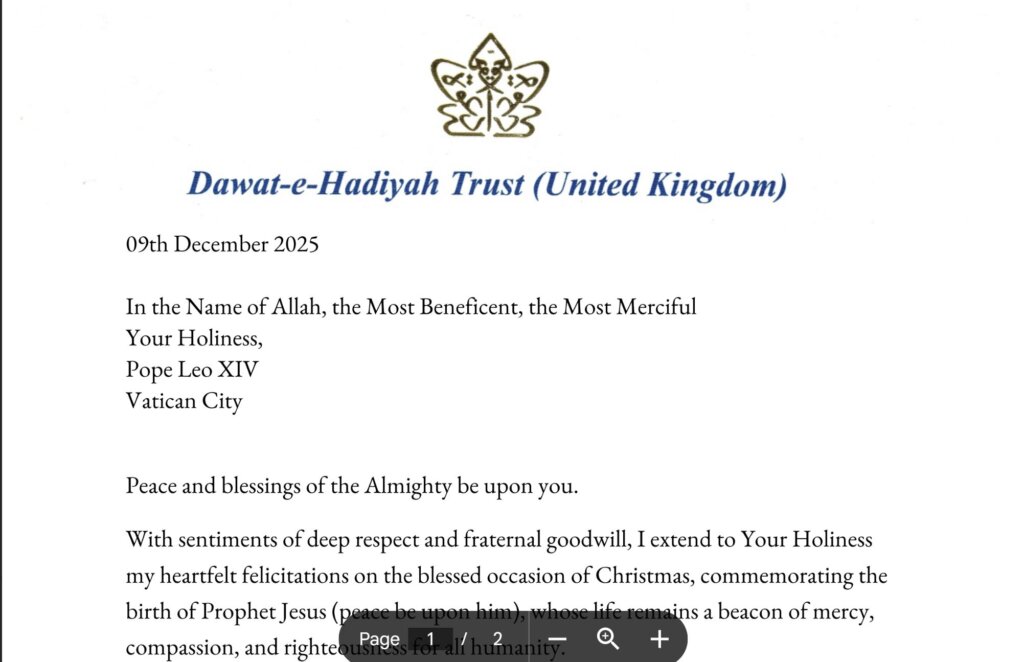
The letter sent by His Holiness Dr Syedna Mufaddal Saifuddin to the Holy Father Pope Leo XIV on the occasion of Christmas is particularly telling. It recognises Jesus Christ as a beacon of mercy and righteousness, and reminds us that love, humility, and service are values that transcend doctrine and geography.
This is inter-faith dialogue at its best: not dilution of belief, but recognition of shared moral ground.
In a world increasingly shaped by polarisation, political, cultural, and even religious, faith leaders carry a unique responsibility. They are not elected by polls nor driven by market forces. Their authority rests on trust, example, and moral consistency. When such leaders choose dialogue over distance, they send a message far beyond their immediate communities: that faith can still be a force for unity rather than division.
Importantly, inter-faith dialogue is not about agreement on theology. It is about agreement on humanity. It is about standing together against violence, hatred, and indifference. It is about affirming that dignity does not belong to one creed alone, but to all people.
I believe that encounters between spiritual leaders, when undertaken with sincerity and humility, can help lower the temperature of global discourse. They remind us that peace is not imposed by power, but built through understanding. They also reaffirm something deeply needed today: moral leadership that does not shout, but listens.
In accepting to explore and support such initiatives, one does not act as a negotiator but as a custodian of values. At a time when institutions are often questioned, and trust is fragile, faith communities still retain an extraordinary capacity to inspire good, charity, and responsibility across borders.
Dialogue, when rooted in faith, is not weakness. It is courage.
And in times such as ours, courage of this kind is not optional—it is essential.